
Selected summaries:
Deep Europe today: Geophysical synthesis of the upper mantle structure and lithospheric processes
over 3.5 Ga
Irina M. Artemieva, Hans Thybo, and Mikhail K. Kaban
Geol. Soc. London Mem., v.32, 2006
We present a summary of geophysical models of the subcrustal lithosphere of Europe. This includes the results from seismic (reflection and
refraction profiles, P- and S-wave tomography, mantle anisotropy), gravity, thermal, electromagnetic, elastic, and petrologic studies of the
lithospheric mantle. We discuss major tectonic processes as reflected in the lithospheric structure of Europe, from Precambrian terrane
accretion and subduction to Phanerozoic rifting, volcanism, subduction and continent-continent collision. The differences in the lithospheric
structure of Precambrian and Phanerozoic Europe, as illustrated by a comparative analysis of different geophysical data, are shown to have
both a compositional and a thermal origin. We propose an integrated model of physical properties of the European subcrustal lithosphere,
with emphasis on the depth intervals around 150 and 250 km. At these depths, seismic velocity models, constrained by body- and surface-
wave continent-scale tomography, are compared with mantle temperatures and mantle gravity anomalies. This comparison provides a
framework for discussion of the physical/chemical origin of the major lithospheric anomalies and their relation to large-scale tectonic
processes, which have formed the present lithosphere of Europe.
Mantle escape inferred from seismic anisotropy in young continental orogens
Meissner R., Mooney W.D., and Artemieva I.M.
Geophys. J. Int., 149, 1-14, 2002.
We have selected observations on seismic anisotropy in the continental crust and uppermost mantle and specifically in young mountain
belts. We argue that they provide important evidence for deformation processes in the crust and the subcrustal lithosphere.
(1) Seismic anisotropy in the brittle upper crust is related to several factors, including orientated cracks, alignment of foliation in
metamorphic rocks, and fine-scale lithologic layering. Cracks are closed in the middle and lower crust, and anisotropy there is due to the
presence of anisotropic minerals (such as biotite and hornblende) that are aligned within a warm, low-viscosity environment. Seismic
anisotropy in the upper mantle is well established worldwide and inferred to be produced by dislocation creep and LPO of anisotropic
minerals, primarily olivine.
(2) Lithospheric rheology plays a dominant role in the creation and preservation of anisotropy in all levels of the lithosphere, thus we
examine the viscosity–depth structure for two types of continental lithosphere. We find that there are two layers within the warm continental
lithosphere that provide favourable conditions for creep and hence for producing anisotropy. The first favourable layer occurs within the
lower crust and the second one begins below the mantle lid, i.e. at a depth of 10–30 km below the Moho. The depth and thickness of these
layers depends on the geothermal gradient, on the crustal and lithospheric thickness, and the composition of the crust and subcrustal
lithosphere.
(3) The process responsible for formation of anisotropic layers in the continental lithosphere can be inferred from an examination of young
orogens. Seismic data (mostly Pn refraction data; Smith & Ekstr¨om 1999) show that anisotropy in the shallow mantle is usually parallel to
the structural axis of mountain belts (i.e. mountainparallel), while compressional tectonic stresses, determined in the upper crust by focal
plane solutions and drilling (Zoback 1992), show strong mountain-perpendicular components. The weak lower crust acts as a decoupling
unit. Our viscosity models show that also the viscosity is anisotropic with the lowest viscosity along the fast axes of olivine orientated along
the streamlines. The anisotropy of viscosity is compatible with the seismic anisotropy. It initiates an alignment of the anisotropic minerals and
provides a feedback mechanism for stabilizing creep and seismic anisotropy along the fast mineral axes.
(4) We summarize observations of seismic anisotropy and upper crustal stress directions for Tibet, for the young mountains north of the
Mediterranean Sea, and for young mountain belts in the Americas. Based on the strong azimuthal discrepancy between the mantle
anisotropy and the crustal stresses, we postulate, in agreement with earlier suggestions (Vauchez & Nicolas 1991), that mountainparallel
creep occurs in the uppermost mantle beneath young orogens. Creep might become more pronounced and evolve into tectonic escape
under special conditions, such as the existence of a weak tectonic unit near to the axis of the orogen. We extend the concept of tectonic
escape (Burke & Seng¨or 1986) to the whole lithosphere. The weak layers in the lower crust and the upper mantle provide the condition for
pronounced creep under stress. The compression of a horizontal, open toothpaste tube is a simple physical analogue for the initiation of
creep and tectonic escape.
Influence of volatiles in the upper mantle on the dynamics of thermal thinning of the lithosphere.
Artemieva, I. M.
Journal of Geodynamics, 11: 77-97, 1989.
Areas of Cenozoic tectonic and magmatic activity (including high plateaus and continental rifts) are characterized by anomalous low-velocity
and low-density zones in the upper mantle. Petrochemical studies of Cenozoic volcanism have revealed such changes of magma
composition with time that prove a consecutive uplift of magma sources. Thus, it is supposed that the process of tectonic rejuvenation is
caused by an ascent of anomalous mantle to the base of the lithosphere, resulting in partial melting of lithospheric material, its consecutive
replacement by material from the anomalous mantle, lithosphere thinning, and, hence, isostatic uplift of lithospheric blocks.
A model of thermal thinning of the lithosphere that is specified by a 1-D heat-conductivity problem for the lithosphere with a moving lower
boundary, is proposed as a model of Cenozoic tectonic activation. The presence of H20 and CO2 fluids in the upper mantle is taken into
account.
Numerical modelling of the process has revealed that the composition of the upper mantle and fluid phase has a strong influence on the
dynamics of the process. The presence of volatiles in the upper mantle leads to the appearance of maxima and minima on the solidus
curves. Lamination of fusible and refractory layers in the upper mantle may lead to a sharp change in lithosphere-thinning velocities and,
hence, to a discrete character of surface vertical motions.
The thickness of the lithosphere in a new equilibrium position is calculated for a different composition of the upper mantle and different
values of heat flow supplied to the base of the lithosphere; the results show
that for the models that seem best to fit present knowledge of the upper mantle composition, melting of the lower crust may take place only
in the later stages of the process, when the lithosphere-anomalous mantle boundary approaches its new equilibrium position.
Processes of lithosphere evolution: New evidence on the structure of the continental crust and
upper mantle.
Artemieva I.M., Mooney W.D., Perchuc E., and Thybo H.
Tectonophysics. v. 358, 1-15, 2002.
We summarize new geophysical evidence for the processes that determine the evolution of the continental lithosphere since the early
Archean. These processes are related to plate tectonics and include:
(1) Growth of Precambrian continental lithosphere by collision and accretion of terranes and by subduction, as supported by new seismic
interpretations of the Baltic Shield and the western part of the East European Platform.
(2) Growth of Phanerozoic continental lithosphere by continent-ocean collisions, terrane accretion and associated subduction, as evidenced
by new seismic tomography results for the Hercynian Range in western France, the Alpine-Himalayan belt, the Mediterranean area, and
Kamchatka.
(3) Break-up and modification of the continental lithosphere during active or passive continental rifting as illustrated by recent tomographic
studies of four modern continental rifts (the Kenya, Baikal, and Rio Grande rifts and the Rhine Graben).
(4) Erosion of the continental lithosphere by mantle convection as illustrated by the analysis of the effect of plate motion on basal drag.
Seismic models of rheologically weak low-velocity zones in the upper mantle provide additional constraints for the observed correlation
between plate velocities and lithospheric thickness.
(5) Regional and global data on seismic anisotropy provides information on the convection pattern in the upper mantle and on the thickness
of the continental lithosphere.
Deep Europe today: Geophysical synthesis of the upper mantle structure and lithospheric processes
over 3.5 Ga
Irina M. Artemieva, Hans Thybo, and Mikhail K. Kaban
Geol. Soc. London Mem., v.32, 2006
We present a summary of geophysical models of the subcrustal lithosphere of Europe. This includes the results from seismic (reflection and
refraction profiles, P- and S-wave tomography, mantle anisotropy), gravity, thermal, electromagnetic, elastic, and petrologic studies of the
lithospheric mantle. We discuss major tectonic processes as reflected in the lithospheric structure of Europe, from Precambrian terrane
accretion and subduction to Phanerozoic rifting, volcanism, subduction and continent-continent collision. The differences in the lithospheric
structure of Precambrian and Phanerozoic Europe, as illustrated by a comparative analysis of different geophysical data, are shown to have
both a compositional and a thermal origin. We propose an integrated model of physical properties of the European subcrustal lithosphere,
with emphasis on the depth intervals around 150 and 250 km. At these depths, seismic velocity models, constrained by body- and surface-
wave continent-scale tomography, are compared with mantle temperatures and mantle gravity anomalies. This comparison provides a
framework for discussion of the physical/chemical origin of the major lithospheric anomalies and their relation to large-scale tectonic
processes, which have formed the present lithosphere of Europe.
Mantle escape inferred from seismic anisotropy in young continental orogens
Meissner R., Mooney W.D., and Artemieva I.M.
Geophys. J. Int., 149, 1-14, 2002.
We have selected observations on seismic anisotropy in the continental crust and uppermost mantle and specifically in young mountain
belts. We argue that they provide important evidence for deformation processes in the crust and the subcrustal lithosphere.
(1) Seismic anisotropy in the brittle upper crust is related to several factors, including orientated cracks, alignment of foliation in
metamorphic rocks, and fine-scale lithologic layering. Cracks are closed in the middle and lower crust, and anisotropy there is due to the
presence of anisotropic minerals (such as biotite and hornblende) that are aligned within a warm, low-viscosity environment. Seismic
anisotropy in the upper mantle is well established worldwide and inferred to be produced by dislocation creep and LPO of anisotropic
minerals, primarily olivine.
(2) Lithospheric rheology plays a dominant role in the creation and preservation of anisotropy in all levels of the lithosphere, thus we
examine the viscosity–depth structure for two types of continental lithosphere. We find that there are two layers within the warm continental
lithosphere that provide favourable conditions for creep and hence for producing anisotropy. The first favourable layer occurs within the
lower crust and the second one begins below the mantle lid, i.e. at a depth of 10–30 km below the Moho. The depth and thickness of these
layers depends on the geothermal gradient, on the crustal and lithospheric thickness, and the composition of the crust and subcrustal
lithosphere.
(3) The process responsible for formation of anisotropic layers in the continental lithosphere can be inferred from an examination of young
orogens. Seismic data (mostly Pn refraction data; Smith & Ekstr¨om 1999) show that anisotropy in the shallow mantle is usually parallel to
the structural axis of mountain belts (i.e. mountainparallel), while compressional tectonic stresses, determined in the upper crust by focal
plane solutions and drilling (Zoback 1992), show strong mountain-perpendicular components. The weak lower crust acts as a decoupling
unit. Our viscosity models show that also the viscosity is anisotropic with the lowest viscosity along the fast axes of olivine orientated along
the streamlines. The anisotropy of viscosity is compatible with the seismic anisotropy. It initiates an alignment of the anisotropic minerals and
provides a feedback mechanism for stabilizing creep and seismic anisotropy along the fast mineral axes.
(4) We summarize observations of seismic anisotropy and upper crustal stress directions for Tibet, for the young mountains north of the
Mediterranean Sea, and for young mountain belts in the Americas. Based on the strong azimuthal discrepancy between the mantle
anisotropy and the crustal stresses, we postulate, in agreement with earlier suggestions (Vauchez & Nicolas 1991), that mountainparallel
creep occurs in the uppermost mantle beneath young orogens. Creep might become more pronounced and evolve into tectonic escape
under special conditions, such as the existence of a weak tectonic unit near to the axis of the orogen. We extend the concept of tectonic
escape (Burke & Seng¨or 1986) to the whole lithosphere. The weak layers in the lower crust and the upper mantle provide the condition for
pronounced creep under stress. The compression of a horizontal, open toothpaste tube is a simple physical analogue for the initiation of
creep and tectonic escape.
Influence of volatiles in the upper mantle on the dynamics of thermal thinning of the lithosphere.
Artemieva, I. M.
Journal of Geodynamics, 11: 77-97, 1989.
Areas of Cenozoic tectonic and magmatic activity (including high plateaus and continental rifts) are characterized by anomalous low-velocity
and low-density zones in the upper mantle. Petrochemical studies of Cenozoic volcanism have revealed such changes of magma
composition with time that prove a consecutive uplift of magma sources. Thus, it is supposed that the process of tectonic rejuvenation is
caused by an ascent of anomalous mantle to the base of the lithosphere, resulting in partial melting of lithospheric material, its consecutive
replacement by material from the anomalous mantle, lithosphere thinning, and, hence, isostatic uplift of lithospheric blocks.
A model of thermal thinning of the lithosphere that is specified by a 1-D heat-conductivity problem for the lithosphere with a moving lower
boundary, is proposed as a model of Cenozoic tectonic activation. The presence of H20 and CO2 fluids in the upper mantle is taken into
account.
Numerical modelling of the process has revealed that the composition of the upper mantle and fluid phase has a strong influence on the
dynamics of the process. The presence of volatiles in the upper mantle leads to the appearance of maxima and minima on the solidus
curves. Lamination of fusible and refractory layers in the upper mantle may lead to a sharp change in lithosphere-thinning velocities and,
hence, to a discrete character of surface vertical motions.
The thickness of the lithosphere in a new equilibrium position is calculated for a different composition of the upper mantle and different
values of heat flow supplied to the base of the lithosphere; the results show
that for the models that seem best to fit present knowledge of the upper mantle composition, melting of the lower crust may take place only
in the later stages of the process, when the lithosphere-anomalous mantle boundary approaches its new equilibrium position.
Processes of lithosphere evolution: New evidence on the structure of the continental crust and
upper mantle.
Artemieva I.M., Mooney W.D., Perchuc E., and Thybo H.
Tectonophysics. v. 358, 1-15, 2002.
We summarize new geophysical evidence for the processes that determine the evolution of the continental lithosphere since the early
Archean. These processes are related to plate tectonics and include:
(1) Growth of Precambrian continental lithosphere by collision and accretion of terranes and by subduction, as supported by new seismic
interpretations of the Baltic Shield and the western part of the East European Platform.
(2) Growth of Phanerozoic continental lithosphere by continent-ocean collisions, terrane accretion and associated subduction, as evidenced
by new seismic tomography results for the Hercynian Range in western France, the Alpine-Himalayan belt, the Mediterranean area, and
Kamchatka.
(3) Break-up and modification of the continental lithosphere during active or passive continental rifting as illustrated by recent tomographic
studies of four modern continental rifts (the Kenya, Baikal, and Rio Grande rifts and the Rhine Graben).
(4) Erosion of the continental lithosphere by mantle convection as illustrated by the analysis of the effect of plate motion on basal drag.
Seismic models of rheologically weak low-velocity zones in the upper mantle provide additional constraints for the observed correlation
between plate velocities and lithospheric thickness.
(5) Regional and global data on seismic anisotropy provides information on the convection pattern in the upper mantle and on the thickness
of the continental lithosphere.
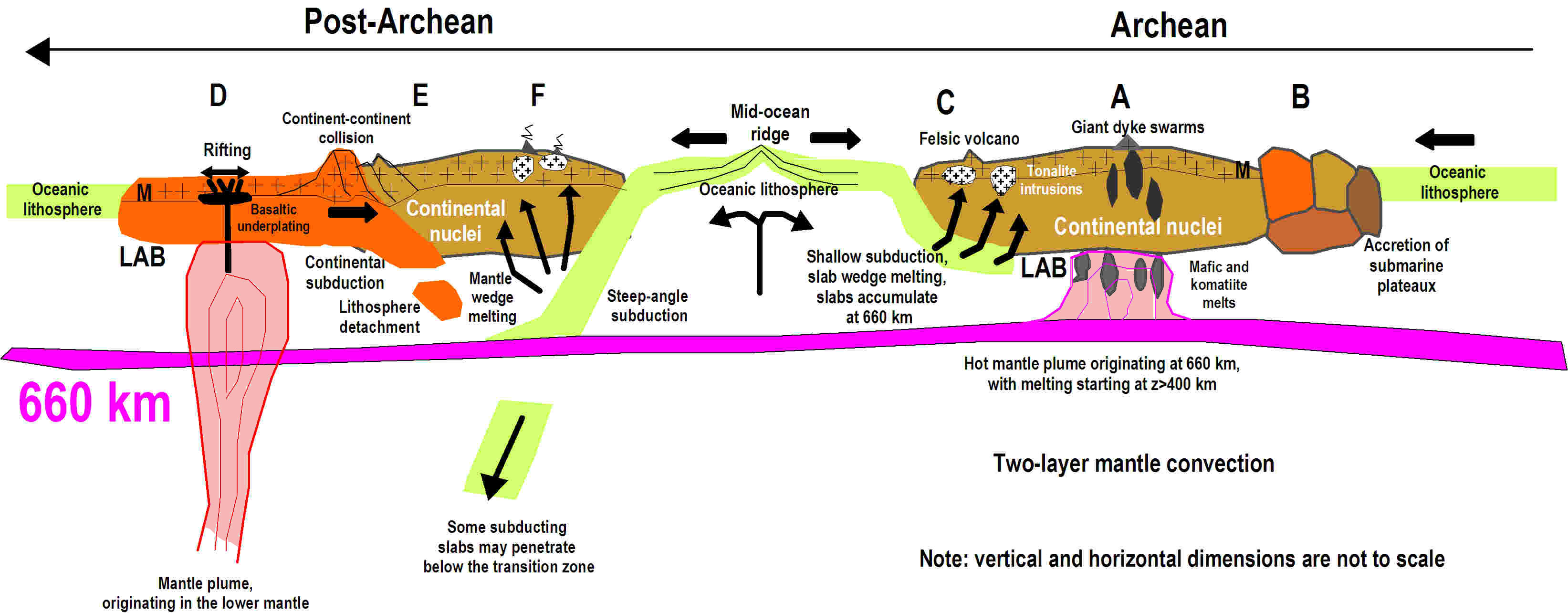
| Major processes of lithosphere formation and modification in Archean and post-Archean time. Early continental lithosphere (right) (with the focus on processes characteristic of the Archean). A: Assembly of continental nuclei above hot mantle plumes, originating from a depth of 660 km, and generation of first giant dyke swarms. B: Growth of an Archean craton by the accretion of submarine plateaux. C: Growth of Archean continental crust by melting within the slab wedge during buoyant subduction. Post-Archean (left) (with the focus on processes that did not operate during the Archean). D: Rifting and basalt underplating caused by lower mantle plumes. E: Collisional orogens, continental subduction and lithosphere detachment. F: Crustal growth by melting in the mantle wedge during steep subduction. Some subducted slabs sink into the lower mantle. LAB = lithosphere-asthenosphere boundary; M = crustal base. |
| Last modified June, 2006; irina@geol.ku.dk |


Irina Artemieva: Research highlights
- THE CONTINENTAL LITHOSPHERE
 |
 |
 |
 |
 |
 |
 |
 |
 |
 |
 |
- THE CONTINENTAL LITHOSPHERE


| THERMAL REGIME, STRUCTURE, AND EVOLUTION OF |
This site is currently being updated, Dec. 2013